Bangladesh is one of the most open economies in South Asia for foreign investment. In most sectors, foreign investors can own 100% of a company, take profits home, and get the same treatment as local investors. A domestic market of over 170 million people, a large young workforce and a growing network of economic zones keep it on the shortlist for manufacturers, tech firms and service companies.
But open doesn’t mean simple. You need to choose the right entry structure, clear several regulators, and keep up with ongoing compliance. This guide explains how foreign investment in Bangladesh works in 2026, from the legal framework to the approvals you need on day one.
The Legal Framework for Foreign Investment
Four laws and regulators shape foreign investment in Bangladesh:
- Foreign Private Investment (Promotion and Protection) Act 1980. Guarantees equal treatment, protection against expropriation, and the right to repatriate capital and profits.
- Bangladesh Investment Development Authority Act 2016. Created BIDA, the main investment promotion and facilitation agency for projects outside the economic zones.
- Economic zones and EPZs. Projects inside economic zones fall under BEZA. Projects in export processing zones fall under BEPZA. Each runs its own approvals and incentives.
- Bangladesh Bank. Regulates inward remittance of capital, foreign loans, and repatriation of dividends under the Foreign Exchange Regulation Act 1947.
Company law itself comes from the Companies Act 1994, administered by the Registrar of Joint Stock Companies and Firms (RJSC).
Which Sectors Are Open to Foreign Investors?
The general rule is simple: if a sector is not restricted, it is open, and 100% foreign ownership is allowed.
| Category | What it means | Examples |
|---|---|---|
|
Open |
100% foreign ownership, no prior sector approval
|
IT and software, manufacturing, textiles, pharmaceuticals, consulting, most services
|
|
Controlled
|
Allowed, but needs a licence or clearance from a sector regulator
|
Banking and finance, insurance, power generation, deep-sea fishing, telecom
|
|
Ownership limits
|
Foreign shareholding capped, local partner needed
|
Freight forwarding, shipping, customs agents, aviation, some telecom services
|
|
Reserved
|
Closed to private investment
|
Arms and ammunition, nuclear energy, security printing and minting, extraction in reserved forests
|
Sector lists change through industrial policy updates. Confirm your sector with BIDA or an adviser before you commit capital.
Entry Options for Foreign Investors
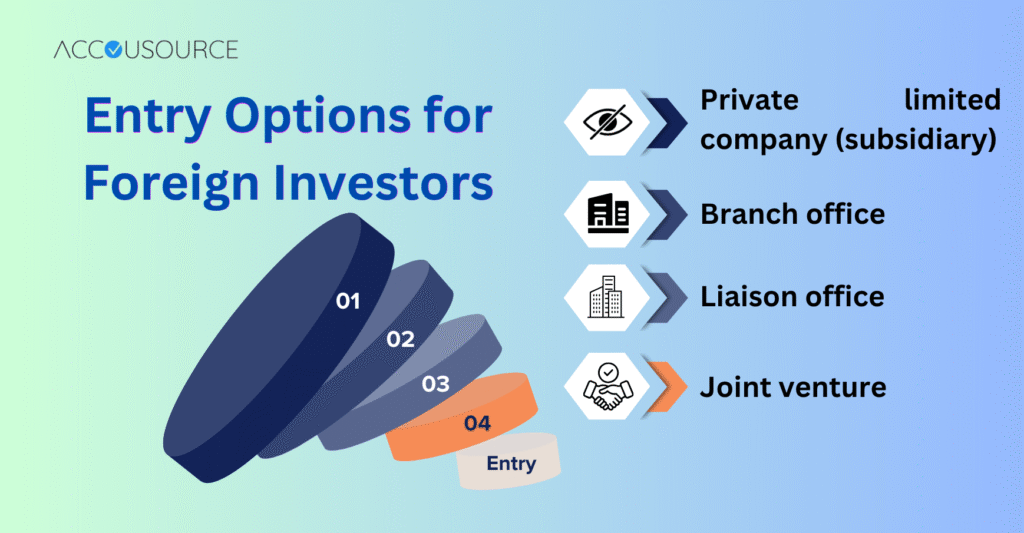
Most foreign investors choose one of four structures:
Private limited company (subsidiary). The most common route. It needs at least two shareholders (individuals or companies) and two directors, and it can be 100% foreign-owned. There is no general minimum capital, but work permits for foreign staff usually require at least USD 50,000 of inward remittance. It can trade, invoice and hire staff without restriction.
Branch office. An extension of the foreign parent, with no separate legal identity. It needs BIDA permission and suits companies carrying out specific contracts or projects. The parent carries full liability.
Liaison office. For market research, promotion and coordination only. It cannot earn revenue in Bangladesh and must be funded by the parent through inward remittance.
Joint venture. A company shared with a local partner. It is required in sectors with ownership limits, and useful where local networks matter.
For most investors planning to sell, hire or build in Bangladesh, a private limited company gives the most flexibility.
Incentives and Tax Benefits
Bangladesh offers a broad set of fiscal and non-fiscal incentives:
- Tax holidays. Depending on sector and location, eligible industries can get reduced tax for 5 to 10 years. Economic zones and hi-tech parks offer the most generous terms.
- Duty benefits. Reduced or zero customs duty on capital machinery for qualifying projects, and bonded warehouse facilities for export-oriented industries.
- Accelerated depreciation. Available as an alternative to a tax holiday for some industrial projects.
- Full repatriation. Profits, dividends, capital gains and invested capital can be repatriated through scheduled banks, subject to tax and documentation.
- Double taxation treaties. Bangladesh has tax treaties with a long list of countries, including the UK, the USA, China, India, Japan and Singapore. These can lower withholding tax on dividends, interest and royalties.
- Export incentives. Cash incentives for selected export products and support for 100% export-oriented units.
Incentives are rarely automatic. Most must be applied for, and many depend on keeping clean books and filing returns on time.
Key Approvals and Timeline
A typical foreign-owned private limited company goes through these steps:
- Name clearance at RJSC (1–2 days).
- Opening a temporary bank account and remitting the initial capital from abroad, with an encashment certificate from the bank.
- Incorporation at RJSC, with the Memorandum and Articles of Association (about 3–7 days once documents are ready).
- Trade licence from the local city corporation.
- e-TIN registration with the National Board of Revenue.
- BIN registration for VAT.
- BIDA registration through the One Stop Service portal.
- Work permits and visas for foreign directors and staff.
- Import Registration Certificate (IRC) or Export Registration Certificate (ERC), if you will trade goods.
Realistically, plan for 4 to 8 weeks from the first documents to an operating company. Foreign documents must be notarised and attested by the Bangladesh mission in your country, and this step causes most delays.
Risks and Practical Challenges
Investors who do well in Bangladesh plan around a few common pain points:
- Banking documentation. Every inward and outward remittance needs supporting documents. Missing paperwork can hold up dividend repatriation.
- Foreign exchange pressure. The taka has weakened in recent years. Model currency risk in your business case.
- Compliance load. Monthly VAT returns, withholding tax returns, annual RJSC filings, statutory audits and quarterly FDI reporting to BIDA and Bangladesh Bank all add up.
- Regulatory change. Tax rates and rules change with each Finance Act. You need an adviser who tracks updates.
None of these are deal-breakers, but they are why most foreign companies use a local corporate services partner from the start.
How AccouSource Helps Foreign Investors
AccouSource takes foreign companies from first inquiry to fully compliant operations. We handle company formation, BIDA registration, work permits, accounting, VAT, tax and payroll in one place. Tell us your sector and plans, and we’ll recommend the right entry structure and a realistic timeline. [Talk to our team]