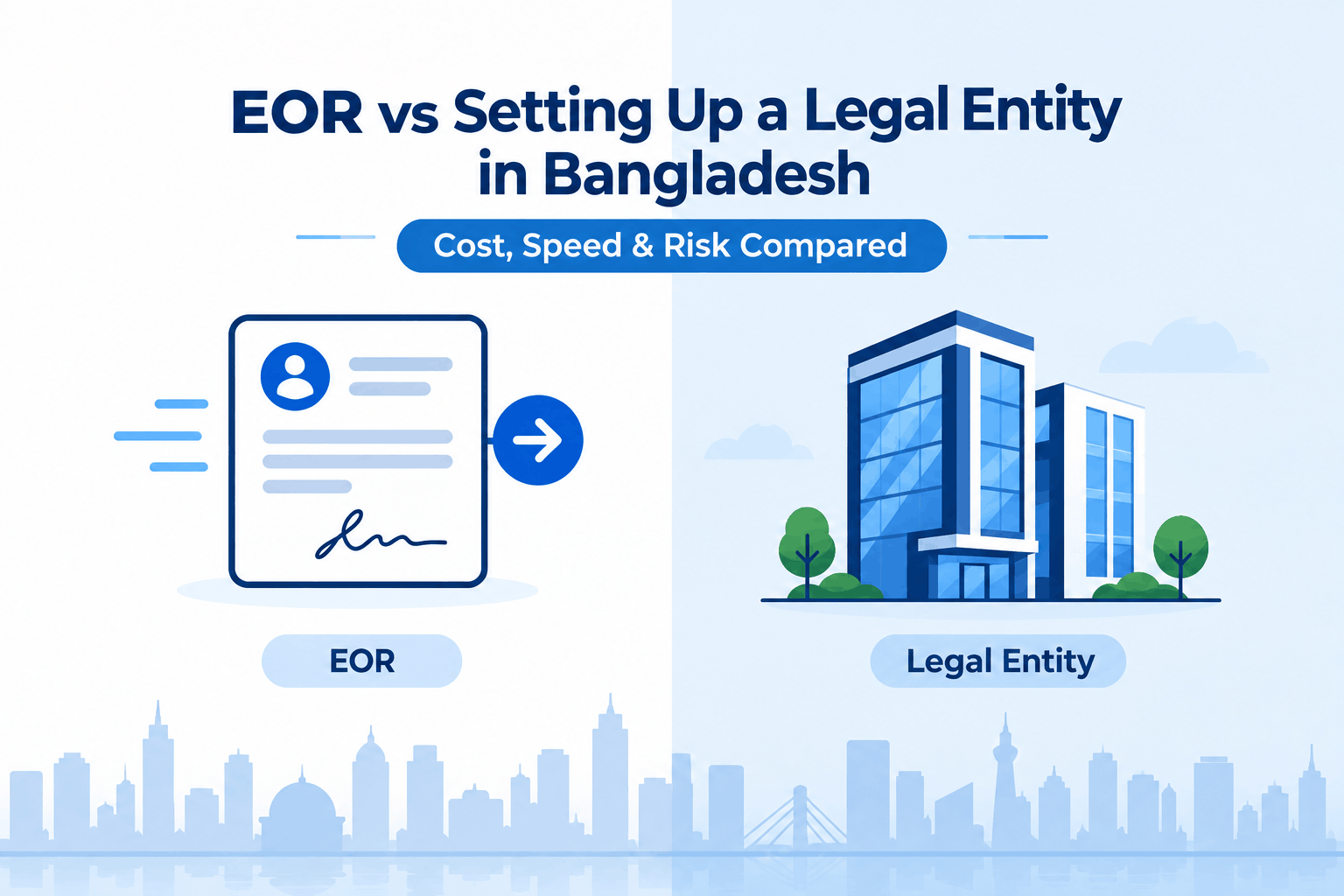
An Employer of Record (EOR) is faster and cheaper for a small team in Bangladesh. You can usually hire within 1–2 weeks, with no company to set up or close. Your own legal entity takes 6–9 weeks to become fully operational and carries yearly audit, tax and filing duties. It becomes the better choice once you have a larger team, want to earn revenue locally, or plan to stay for the long term. Many companies start with an EOR and switch to an entity later.
At a glance
| Factor | EOR | Your own entity (private limited company) |
|---|---|---|
|
Time to first hire
|
About 1–2 weeks
|
About 6–9 weeks including post-incorporation registrations
|
|
Upfront cost
|
None beyond the first month’s fee
|
Registration fees, legal drafting, paid-up capital
|
|
Ongoing cost
|
Monthly EOR fee per employee plus employment costs
|
Accounting, audit, tax filing, company secretarial and HR admin
|
|
Who is the legal employer
|
The EOR
|
Your company
|
|
Can you invoice and earn revenue locally?
|
No
|
Yes
|
|
Can you sponsor expat work permits?
|
Limited; depends on the provider
|
Yes, once registered with BIDA
|
|
Permanent establishment risk
|
Present if staff close sales or sign contracts
|
Not an issue; you’re already taxed locally
|
|
Exit
|
End the EOR contract with notice
|
Close the company through a formal winding-up
|
|
Best for
|
Testing the market, small teams, fast hires
|
Larger teams, local sales, long-term presence
|
Speed to hire
With an EOR, the provider already has a Bangladeshi company, payroll and contracts in place. Once your candidate accepts, they can usually start within 1–2 weeks. The main wait is their notice period with their current employer.
Setting up your own private limited company takes about 4–6 weeks to incorporation. Then you need a trade license, e-TIN, VAT registration, BIDA registration and an operating bank account, which add another 2–3 weeks. Foreign documents often take the longest to prepare. Our company registration guide walks through every step.
Cost
The two models put the cost in different places.
EOR costs
- A monthly service fee per employee, or a percentage of salary
- The full employment cost: salary, festival bonuses and statutory entitlements, passed through at cost
- No setup or closing costs
Entity costs
- One-off: RJSC fees, stamp duty, legal drafting, licences and registrations. See the company registration cost breakdown.
- Paid-up capital, usually at least USD 50,000 if you’ll sponsor work permits
- Yearly: bookkeeping, statutory audit, corporate and VAT returns, AGM and RJSC filings, trade license renewal
- Staff costs, plus payroll and HR administration (in-house or outsourced)
- Closing costs if you later exit
For one or two employees, the entity’s fixed costs are spread across very few people, so an EOR is almost always cheaper. As the team grows, the EOR fee grows with every hire, while the entity’s fixed costs stay roughly the same.
Compliance burden
With an EOR, the provider carries the employer’s compliance: contracts, salary tax, statutory benefits and terminations under the Bangladesh Labour Act 2006.
With your own entity, all of this is yours, plus company law and tax duties. Every year you must:
- Hold an AGM and file the annual return with RJSC
- Have your accounts audited by a registered auditor
- File the corporate income tax return and monthly VAT returns
- Deduct and deposit withholding tax on salaries, rent and supplier payments
- Renew the trade license by 30 June
Missing these leads to penalties, so most foreign-owned companies outsource accounting and compliance.
Permanent establishment risk
An EOR lets you employ people, but it doesn’t let your foreign company do business in Bangladesh. If EOR staff negotiate and sign contracts, close sales or generate revenue for you locally, the tax authority could treat your company as having a permanent establishment (PE). Your foreign company could then owe Bangladeshi tax on the profit linked to that activity.
EOR works best for roles that support your business from Bangladesh, such as engineering, design, customer support, operations or research. If the role is about selling to Bangladeshi customers, set up an entity or take tax advice first.
When does each option make sense?
Choose an EOR if you:
- Need your first hire to start within weeks
- Are hiring a small team, or testing Bangladesh before committing
- Don’t need to invoice Bangladeshi customers
- Want to keep the option to leave without closing a company
Choose your own entity if you:
- Plan a larger team or a long-term presence
- Will sell, invoice or import locally
- Need to sponsor several expat work permits
- Want access to BIDA, economic zone or EPZ incentives
If you’re not sure which entity type fits, see Private Limited vs Branch vs Liaison Office.
Finding your break-even point
There’s no single headcount where an entity becomes cheaper. It depends on salaries, the EOR fee and how much compliance work you outsource. To find yours, compare three years of costs side by side:
- EOR: monthly fee × employees × 36 months, plus employment costs
- Entity: setup costs, plus yearly accounting, audit, tax and HR costs × 3, plus the same employment costs
- Add the cost of time: how many weeks of delay can you accept before the first hire?
The employment costs are the same either way, so the decision comes down to the EOR fees against the entity’s fixed costs. Ask your provider for both numbers based on your hiring plan.
Moving from EOR to your own entity
Starting with an EOR doesn’t lock you in. A common path:
- Hire your first employees through an EOR and start work.
- Incorporate your company in parallel; it can be operational in 6–9 weeks.
- Register the new company with NBR for payroll tax and set up payroll.
- Transfer employees with new contracts that carry over their length of service and entitlements.
- End the EOR contract once the last employee has moved.
Agree how service length and gratuity carry over before the transfer, so employees don’t lose benefits. A provider that offers both EOR and company setup can run the whole move for you.
Frequently asked questions
Is an EOR cheaper than setting up a company in Bangladesh?
Can I use an EOR and my own entity at the same time?
Does using an EOR create tax risk for my company?
Compare both options with AccouSource
AccouSource offers both EOR and company setup in Bangladesh, so we can cost both options for your hiring plan and move your team across when you’re ready. Get a side-by-side quote.