Foreign companies that want to hire employees in Bangladesh often face the same challenge: they aren’t ready to set up a local entity, but they need compliant local employment fast. Two models are commonly discussed for this — Employer of Record (EOR) and Professional Employer Organization (PEO). Understanding the difference between EOR vs PEO in Bangladesh matters, because they aren’t the same model and carry different legal and compliance implications.
In broad terms, an EOR generally becomes the legal employer of the worker on behalf of the client company, subject to the applicable legal framework. A PEO generally provides HR and employment administration support while the client company may remain the employer, depending on the structure and jurisdiction. The exact legal and compliance treatment in Bangladesh depends on the specific arrangement, applicable law, and the service provider’s structure.
What Is an Employer of Record (EOR)?

An EOR is a third-party organization that formally employs workers on behalf of a client company, handling payroll, employment contracts, statutory compliance, leave and benefits administration, and onboarding/offboarding — while the client company directs the employee’s day-to-day work.
Example: A foreign company wants to hire five employees in Bangladesh but doesn’t yet have a local entity. Through an EOR arrangement, it may be able to employ those workers through a local employment structure the EOR provides, subject to applicable Bangladesh law. This doesn’t eliminate every local legal or tax consideration — it addresses the employment relationship specifically.
Foreign companies typically use EOR services to hire quickly without waiting for entity formation.
What Is a PEO?
A Professional Employer Organization typically supports HR administration, payroll processing, employee benefits, HR compliance, and recruitment or onboarding assistance for a client company that already has an employment structure in place. Depending on the contractual and legal structure, the client company’s status as legal employer may remain distinct from what happens under an EOR model — a PEO arrangement is not automatically equivalent to “co-employment” in every jurisdiction, and this should be confirmed against the specific agreement and applicable Bangladesh law.
EOR vs PEO in Bangladesh: Key Differences
| Factor | EOR | PEO |
|---|---|---|
|
Legal employer
|
Typically the EOR, on the client’s behalf
|
Typically the client company
|
|
Local entity needed
|
Generally not required
|
Client company typically already has one
|
|
Employment contract
|
Usually executed by the EOR
|
Usually executed by the client company
|
|
Payroll
|
Managed by the EOR
|
Administered by the PEO on the client’s behalf
|
|
HR administration
|
Handled by the EOR
|
Outsourced to the PEO
|
|
Compliance responsibility
|
Largely with the EOR, per agreement
|
Shared, depending on the contract
|
|
Tax/payroll support
|
Provided as part of the service
|
Provided as part of the service
|
|
Benefits administration
|
Managed by the EOR
|
Managed by the PEO
|
|
Best for
|
Market entry without a local entity
|
Companies with an existing employment structure
|
|
Flexibility for market entry
|
High
|
Lower — assumes a structure is already in place
|
EOR vs PEO: Who Employs the Employee?
Where the exact legal responsibility falls should always be confirmed against the specific service agreement and current Bangladesh law rather than assumed from the table alone.
This is often the most important practical question
Under an EOR model, the EOR typically becomes the formal, legal employer for employment-administration purposes, while the foreign company manages the employee’s day-to-day work and business responsibilities.
Under a PEO model, the client company may remain the employer, with the PEO providing HR, payroll, benefits, and compliance-related services rather than taking on the employment relationship itself.
The exact legal relationship in either case should be confirmed based on applicable Bangladesh law and the actual contractual structure — it isn’t safe to assume every PEO arrangement automatically creates a legal co-employment relationship in Bangladesh.
Payroll, Tax and Compliance
Whichever model is used, expect the arrangement to cover payroll processing and salary payments, employee income tax withholding and documentation, statutory contributions where applicable, employment records and leave/benefits administration, local labor-law compliance, onboarding/offboarding, and regulatory filings where applicable.
Responsibility for each of these varies by provider, employment structure, and applicable law — don’t assume it’s identical across arrangements.
Can a Foreign Company Hire in Bangladesh Without a Local Company?
Often, yes — an EOR or similar compliant arrangement can allow hiring without immediately incorporating locally. But an EOR doesn’t automatically remove every legal or tax consideration: broader activities in Bangladesh may still raise regulatory, tax, permanent-establishment, or business-presence questions depending on the circumstances. EOR shouldn’t be treated as a universal substitute for company registration in Bangladesh, and professional advice should be obtained before starting operations or hiring.
When Should a Foreign Company Choose an EOR?
An EOR tends to suit companies that are:
- Testing the Bangladesh market before committing further
- Hiring a small initial team or remote employees
- Not yet ready to make a long-term investment decision
When Should a Foreign Company Choose a PEO?
A PEO tends to suit companies that:
- Already have an appropriate local employment structure
- Want to outsource HR administration, payroll, or benefits management
- Need HR compliance support without transferring the employer relationship
The key distinction is between an employment structure (EOR) and HR outsourcing (PEO) — they solve different problems.
EOR vs PEO vs Setting Up a Company in Bangladesh
- EOR — best for hiring through an employment structure provided by the EOR, without immediately establishing a local entity, subject to applicable law.
- PEO — best for businesses with an existing employment structure that want to outsource HR/payroll administration.
- Local company — best for companies planning a long-term commercial presence, local revenue generation, and broader business activities.
Neither EOR nor PEO should be treated as a replacement for a local company when a foreign business intends to conduct substantial commercial activities in Bangladesh.
Benefits and Risks to Consider
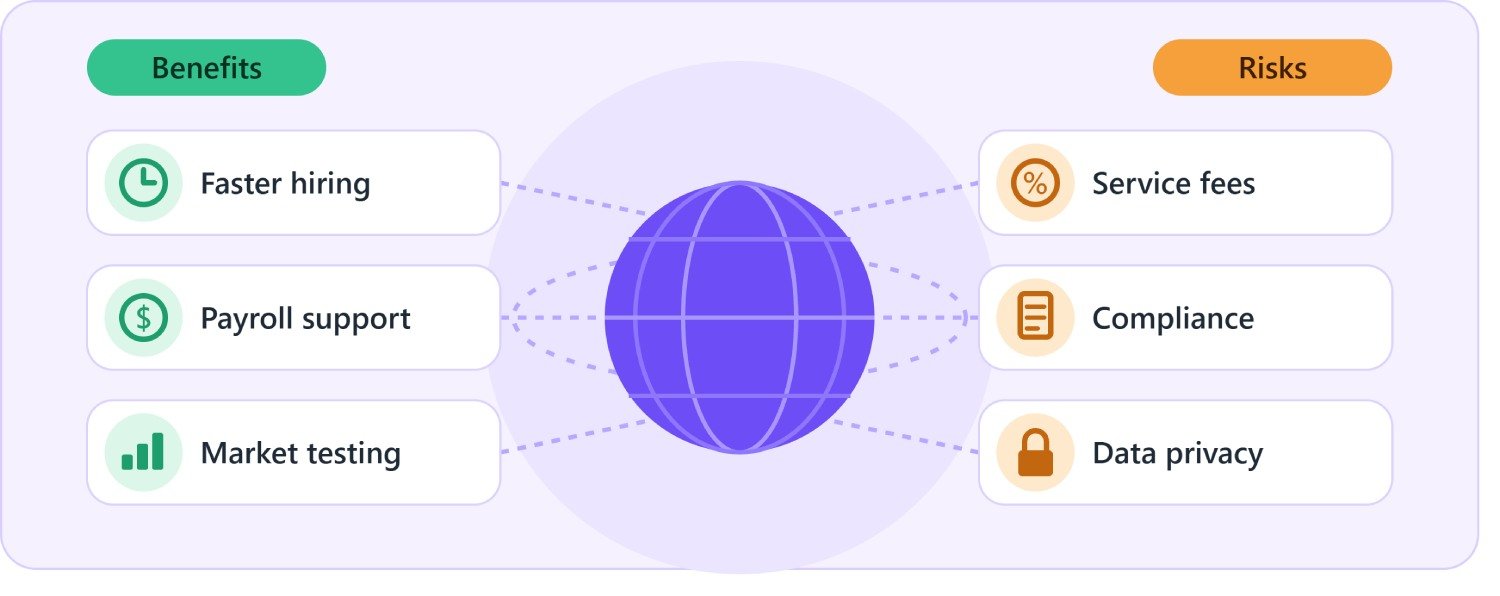
Benefits commonly cited include faster hiring, simplified onboarding, local employment administration, payroll support, and easier market testing — without promising guaranteed compliance or zero legal risk.
Risks to weigh include service fees, limited control over the employment structure, data and privacy considerations, worker classification issues, potential permanent-establishment questions, and dependence on the provider’s own compliance capabilities. A reputable provider and proper professional advice matter.
How to Choose the Right EOR or PEO Provider
Evaluate providers on: Bangladesh legal/compliance expertise, payroll capabilities, contract support, tax compliance, benefits administration, data security, pricing transparency, local support, experience with foreign companies, documentation quality, offboarding procedures, and the ability to support future entity formation as the business grows.
Frequently Asked Questions
What is the difference between EOR and PEO in Bangladesh?
Can a foreign company hire employees in Bangladesh through an EOR?
Does an EOR become the legal employer of the employee?
Does a foreign company need a Bangladesh company to hire employees?
Is a PEO the same as an EOR?
Which is better for a foreign company entering Bangladesh, EOR or PEO?
Can an EOR replace company registration in Bangladesh?
How AccouSource Can Help Foreign Companies
AccouSource supports foreign companies entering Bangladesh with market-entry planning, company registration, corporate compliance, payroll and accounting support, tax compliance, and BIDA-related advisory. We help clients understand which employment or entity structure fits their plans — and support the transition from initial hiring arrangements to a full local business structure as operations grow.
Conclusion
EOR and PEO solve different problems for foreign companies hiring in Bangladesh — one addresses who legally employs the worker, the other addresses HR and payroll outsourcing. Choosing between EOR vs PEO in Bangladesh depends on whether your company already has a local employment structure and how it plans to grow. Neither is automatically a substitute for proper entity registration once commercial activity becomes substantial.
If you’re weighing your options for hiring or expanding into Bangladesh, talk to AccouSource about the structure that fits your plans.