Most business owners don’t start a company to manage ledgers, reconcile bank statements or chase VAT deadlines. Yet without accurate, timely numbers, every decision becomes a guess. That is the gap Client Accounting Services (CAS) are designed to fill.
This guide explains what Client Accounting Services are, what they typically include, how they differ from traditional bookkeeping, and why a growing number of companies, especially foreign-owned businesses operating in Bangladesh, choose to outsource them.
What Are Client Accounting Services (CAS)?
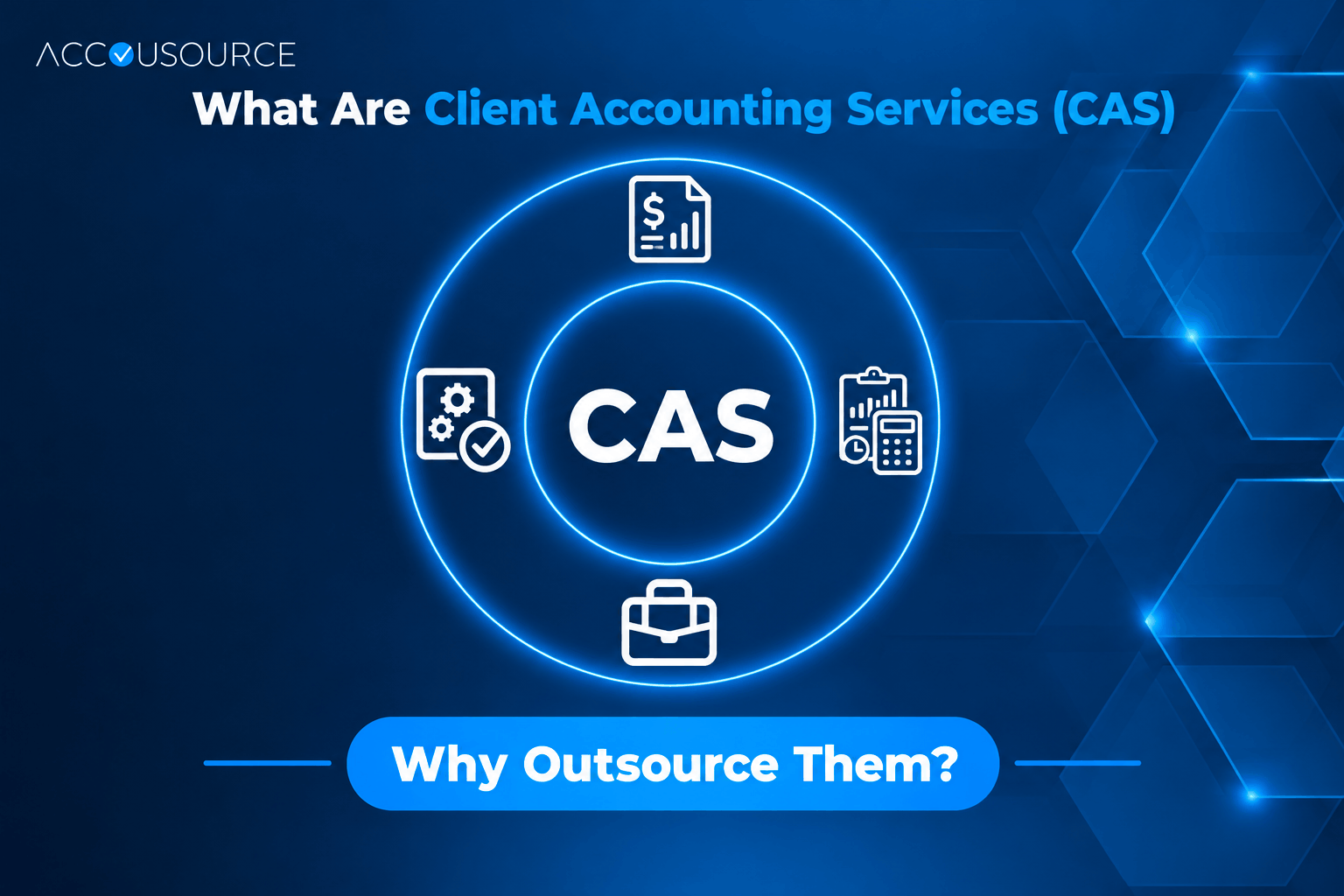
Client Accounting Services (CAS) are an outsourced, ongoing finance function delivered by an accounting firm. Instead of hiring and managing an in-house finance team, a business hands its day-to-day accounting, reporting and financial advisory work to an external provider.
The key word is ongoing. Traditional accounting engagements are often periodic: a firm prepares the annual accounts or files the tax return, then steps away until next year. CAS is a continuous relationship. The provider keeps the books current every month, produces management reports, and helps leadership understand what the numbers mean.
In practice, CAS can range from basic bookkeeping for a small startup to a fully outsourced finance department, including a part-time or “fractional” CFO, for a growing company.
These figures are service fees only. Salary, bonuses, provident fund contributions and other employer costs are billed on top.
What Do Client Accounting Services Include?
The exact scope varies by provider and by client, but most CAS packages are built from the following building blocks.
Bookkeeping and transaction processing
Recording sales, purchases, expenses and receipts, and categorising them correctly in the general ledger. This is the foundation everything else depends on.
Bank and account reconciliations
Matching your accounting records against bank statements, credit cards and supplier balances every month so errors and missing transactions are caught early.
Accounts payable and receivable
Managing supplier invoices and payment runs, issuing customer invoices, and tracking overdue receivables so cash keeps flowing.
Monthly close and financial statements
Closing the books each month and preparing the profit and loss statement, balance sheet and cash flow statement on a consistent timetable.
Management reporting and KPIs
Turning raw financial data into dashboards and reports that show margins, cash runway, budget versus actual performance and other metrics leadership actually uses.
Budgeting, forecasting and cash flow planning
Building annual budgets and rolling forecasts, and modelling scenarios such as hiring plans, price changes or new market entry.
Tax and statutory compliance support
Preparing the records needed for VAT returns, withholding tax, corporate income tax and annual audits, and keeping documentation in order for regulators. In Bangladesh, this means working with National Board of Revenue requirements and the rules that apply to your company type.
Advisory and fractional CFO support
For more mature clients, CAS often extends into strategic advice: pricing, funding, profitability analysis and preparing for investor or board meetings.
CAS vs Traditional Bookkeeping: What's the Difference?
Bookkeeping is one part of CAS, not the whole of it.
| Goal | Traditional bookkeeping | Client Accounting Services (CAS) |
|---|---|---|
|
Focus |
Recording transactions
|
Recording, reporting and advising
|
|
Timing
|
Often reactive or year-end
|
Continuous, monthly cycle
|
|
Output
|
Ledgers and basic records
|
Financial statements, KPIs, forecasts
|
|
Relationship
|
Transactional
|
Ongoing partnership
|
|
Value
|
Accurate records
|
Accurate records plus better decisions
|
In short, bookkeeping tells you what happened. CAS tells you what happened, why it happened, and what to do next.
Why Outsource Client Accounting Services?
The case for outsourcing is not just about saving money, although that is often where the conversation starts.
1. Lower cost than an in-house finance team
A capable in-house finance function needs more than one person. You need someone to process transactions, someone to review the work, and someone senior enough to interpret results and advise management. Add salaries, benefits, festival bonuses, software licences, training and office space, and the cost adds up quickly. With CAS, you pay for the level of service you need and get a full team behind it.
2. Access to expertise you could not hire alone
An outsourced provider brings accountants, tax specialists and senior advisors who work across many businesses. You benefit from that breadth of experience without having to recruit, train and retain each specialist yourself.
3. Stronger compliance and lower risk
Tax rules, VAT requirements and reporting standards change regularly. Late filings, incorrect VAT treatment or missing documentation can lead to penalties and difficult audits. A dedicated CAS provider tracks these changes as part of the job and builds compliance into your monthly routine.
4. Faster, more reliable reporting
Because CAS runs on a fixed monthly cycle, you get financial statements and management reports on time, every month. That makes it easier to spot problems early, manage cash flow and respond to opportunities.
5. Continuity when staff leave
In a small in-house team, one resignation can stall your entire finance function. An outsourced provider has documented processes and backup staff, so your books keep moving regardless of individual staff changes.
6. Scalability as you grow
As transaction volumes increase, or you add new entities, currencies or business lines, a CAS provider can scale the service up without a lengthy hiring process. If activity slows, you can scale back down.
7. More time for the core business
Every hour founders and managers spend on accounting admin is an hour taken away from customers, products and growth. Outsourcing returns that time.
Why CAS Matters for Businesses Operating in Bangladesh
For foreign investors and international companies with a Bangladeshi subsidiary, branch or liaison office, outsourced CAS solves some specific challenges:
- Local compliance knowledge. Bangladesh has its own VAT, withholding tax and corporate reporting requirements. A local provider understands how these work in practice, not just on paper.
- Dual reporting needs. Many foreign-owned companies must keep local statutory records while also reporting to a parent company abroad. CAS providers can prepare both, in the formats and currencies each audience needs.
- Remote oversight. Headquarters teams get clear, regular visibility into the Bangladesh operation without needing finance staff on the ground.
- Easier audits and regulatory filings. Well-maintained monthly records make year-end audits and annual filings far smoother.
When Should You Consider Outsourcing CAS?
Outsourcing is usually worth considering if any of these sound familiar:
- Your books are often weeks or months behind.
- Founders or managers are doing the accounting themselves.
- You are entering Bangladesh and do not yet have a local finance team.
- Your in-house accountant is stretched or about to leave.
- Investors, lenders or your parent company want more regular, reliable reporting.
- You have received tax notices or struggled with VAT compliance.
How to Choose the Right CAS Provider
Not every provider is the right fit. When comparing options, ask:
- Do they have experience with businesses of your size, industry and ownership structure?
- Do they understand local tax and regulatory requirements in Bangladesh?
- What does the monthly service include, and what is charged separately?
- Which accounting software do they use, and will you have real-time access?
- How do they protect your financial data?
- Who will be your day-to-day contact, and how quickly do they respond?
- Can the service grow with you, from bookkeeping to full advisory support?