For many foreign-owned companies, the Bangladesh subsidiary is the hardest entity to close each month. The local books are kept for local tax and VAT. The parent company needs IFRS or US GAAP numbers, in its own chart of accounts, by working day five. The gap between the two shows up as late reporting packs, unexplained variances and difficult audit seasons.
Outsourced financial reporting closes that gap. This guide explains Bangladesh’s reporting rules, where in-house reporting usually breaks down, and how an outsourced model improves accuracy.
Financial Reporting Requirements in Bangladesh
Several overlapping rules shape a company’s reporting obligations:
- Companies Act 1994. Every company must prepare annual financial statements under the reporting standards that apply in Bangladesh, have them audited, and present them at the AGM.
- Financial Reporting Act 2015. Created the Financial Reporting Council (FRC). The FRC adopted IFRS without modification in 2020, and International Standards on Auditing in 2021.
- Public interest entities (PIEs). Entities defined as PIEs must apply IFRS as adopted by the FRC. Their auditors must be enlisted with the FRC. Size-based criteria can bring some larger private companies into scope, so check where yours stands.
- RJSC filings. The annual return is due within 21 days of the AGM, and audited financial statements within 30 days.
- NBR. The corporate tax return must include audited accounts. Audit reports now need a Document Verification Code (DVC) from ICAB before submission to NBR or RJSC.
- BIDA and Bangladesh Bank. Foreign-owned companies also submit regular FDI reports.
The default income year is July to June, so many subsidiaries also need a bridge between local and group year-ends.
Where In-House Reporting Usually Goes Wrong
Most reporting problems aren’t caused by bad accountants. They come from a small team doing too many jobs. The most common issues:
- Unreconciled balances. Bank, VAT, withholding tax and intercompany accounts that nobody reconciles monthly.
- Missing accruals. Costs booked when paid rather than when incurred, which makes month-end results swing.
- Related-party transactions. Management fees, royalties and recharges booked differently in Dhaka and at head office.
- Foreign currency translation. Remittances and foreign-currency payables revalued inconsistently, or not at all.
- Mapping errors. A local chart of accounts that doesn’t map cleanly to the group’s, so every pack needs manual adjustment.
- Key-person risk. One accountant who knows how everything works, and a close that stops when they are on leave.
How Outsourcing Improves Accuracy
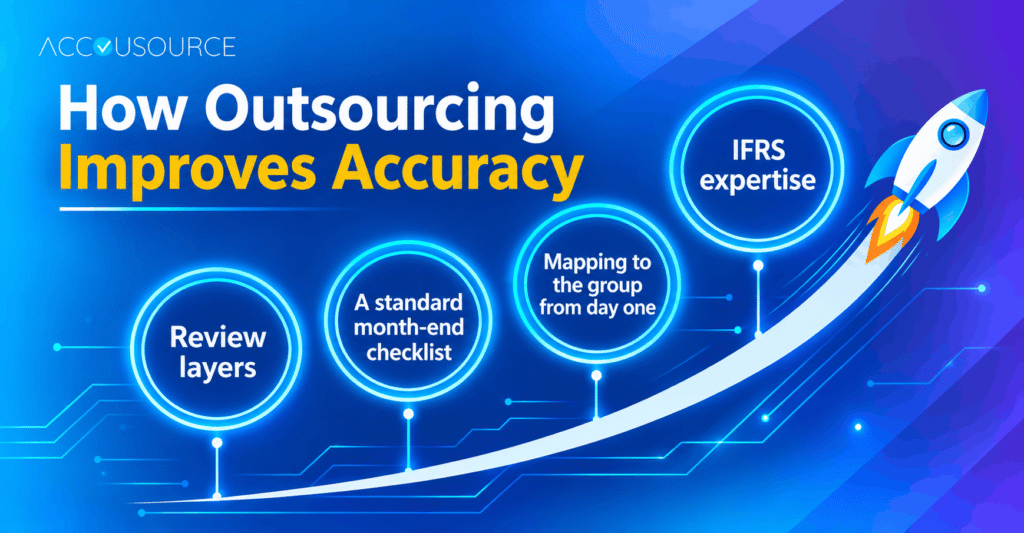
A good outsourced reporting team brings structure that a single in-house accountant rarely has time to build:
Review layers. Every set of accounts is prepared by one person and reviewed by another, usually a qualified accountant. Errors are caught before they reach head office.
A standard month-end checklist. Each close follows the same documented steps, so nothing depends on memory.
Mapping to the group from day one. The local ledger is designed to support both Bangladesh statutory reporting and the parent’s reporting pack. Local tax and VAT stay correct, and group numbers come out without manual rework.
IFRS expertise. Areas like IFRS 15 (revenue), IFRS 16 (leases) and IAS 21 (foreign exchange) are handled by people who apply them every month.
Continuity. Staff turnover at the provider doesn’t stop your close.
A Typical Monthly Close and Reporting Cycle
- Day 1–2: Bank reconciliations, sales and purchase cut-off, payroll journal.
- Day 2–3: Accruals and prepayments, depreciation, and revaluation of foreign currency balances.
- Day 3: VAT, withholding tax and intercompany reconciliations.
- Day 4: Draft trial balance, mapped to the group chart of accounts.
- Day 5: Reporting pack, variance commentary and key balance-sheet schedules sent to the parent company.
- Day 6–10: Head-office queries resolved and adjustments posted. The month is locked.
Timelines depend on how fast documents arrive. The structure stays the same each month.
Preparing for the Statutory Audit
A company with clean monthly closes is mostly ready for audit already. To make year-end smoother:
- Keep a permanent audit file: incorporation documents, BIDA registration, key contracts and loan agreements.
- Prepare lead schedules that support every balance-sheet line, tied to source documents.
- Reconcile VAT and withholding tax records with NBR filings before the auditors arrive.
- Agree related-party balances with the parent in writing.
- Make sure your auditor is FRC-enlisted if your company is, or may become, a public interest entity.
What to Look for in a Reporting Partner
- Qualified accountants (ACA, ACCA, CMA) who review the work
- Experience with group reporting packs and your parent company’s GAAP
- Bangladesh tax and VAT knowledge, so local and group numbers stay consistent
- Clear service levels for close dates and turnaround on queries
- Secure systems, defined access rights and a confidentiality agreement
How AccouSource Can Help
AccouSource prepares monthly management accounts, group reporting packs and audit-ready statutory financial statements for foreign-owned companies in Bangladesh. We work to your parent company’s timetable and format. [Book a reporting review →]