Payroll mistakes in Bangladesh rarely show up on the day they happen. They show up months later, as an NBR notice, a disallowed salary expense, a labour court claim, or a group of employees who no longer trust their payslips. The Income Tax Act 2023 and the Bangladesh Labour Act 2006 (amended again in 2025 and 2026) set strict rules on how salaries are calculated, taxed and paid.
These are the 10 mistakes we see most often, what each one risks, and how to fix it.
1. Deducting Tax on Salary at the Wrong Rate
The mistake: Deducting tax using the slab rate on one month’s salary, or a flat percentage.
The risk: Section 86 of the Income Tax Act 2023 requires employers to deduct tax at the average rate on the employee’s estimated annual income. Under-deducting makes the employer liable for the shortfall, plus interest.
The fix: Estimate each employee’s annual taxable income at the start of the income year (July). Include the bonuses and benefits you expect to pay. Recalculate whenever pay changes.
2. Depositing Withheld Tax Late
The mistake: Deducting tax from salaries but depositing it to the government late.
The risk: Tax deducted from July to May must be deposited within two weeks after the end of the month. June has shorter deadlines. Late deposits attract simple interest of 2% per month. Failing to deposit deducted tax can also lead to prosecution.
The fix: Treat the deposit date like salary day. Pay by challan or electronically, and keep the proof with your payroll records.
3. Missing Withholding Tax Returns and Salary Statements
The mistake: Depositing tax correctly but never filing the returns.
The risk: Employers must file quarterly withholding tax returns under Section 177. They are due on 25 October, 25 January, 25 April and 25 July. The annual salary statement goes with the October return. Not filing can lead to penalties and a tax audit.
The fix: Put all four dates in a compliance calendar, and assign one person to own them.
4. Ignoring Proof of Return Submission (PSR)
The mistake: Not collecting proof of tax return submission from eligible employees.
The risk: If management, administrative or supervisory staff don’t provide PSR, their salaries can be disallowed as a business expense. That raises the company’s corporate tax.
The fix: Collect PSRs every year after the individual filing deadline, and keep a register of them.
5. Paying Salaries Late
The mistake: Paying salaries “around the 10th” when cash is tight.
The risk: Section 123 of the Labour Act requires wages to be paid within seven working days after the end of the wage period. The wage period cannot be longer than one month. Late payment leads to claims, inspections and fines.
The fix: Set a fixed pay date before the seventh working day, and plan your cash flow around it. Pay through a bank or mobile financial service so there is a clear payment record.
6. Calculating Overtime Wrongly
The mistake: Paying overtime at the normal rate, or calculating it on gross salary.
The risk: Section 108 requires overtime at twice the ordinary rate. The ordinary rate is calculated on basic wage plus dearness allowance (and any ad-hoc or interim wage), not gross pay. Underpayment adds up quickly in factories and shift-based teams.
The fix: Use a payroll system that pulls hours from attendance records and applies the statutory formula automatically.
7. Getting Festival Bonuses Wrong
The mistake: Skipping festival bonuses, paying the wrong amount, or paying them late.
The risk: Under Rule 111(5) of the Bangladesh Labour Rules 2015, workers with one year of continuous service are entitled to two festival bonuses a year. Each can be up to one month’s basic wage. Mistakes here lead to disputes very quickly.
The fix: Write the bonus policy into appointment letters. Track each employee’s service date, and budget for both bonuses at the start of the year.
8. Overlooking WPPF Obligations
The mistake: Assuming the Workers’ Profit Participation Fund only applies to factories.
The risk: Chapter XV of the Labour Act applies to any company with paid-up capital of at least Tk 1 crore, or fixed assets of at least Tk 2 crore, on the last day of its accounting year. Qualifying companies must pay 5% of the previous year’s net profit within nine months of year-end. It is split 80:10:10 between the Participation Fund, the Welfare Fund and the Bangladesh Workers’ Welfare Foundation Fund.
The fix: Check the capital and asset tests at every year-end. Set up the WPPF trust properly, and put the payment deadline in your calendar.
9. Miscalculating Final Settlements
The mistake: Leaving out leave encashment, gratuity or notice pay when someone leaves, or paying it months later.
The risk: Final dues must be paid within 30 working days after employment ends. Where gratuity applies, it is at least 30 days’ wages per completed year of service, and 45 days per year for service over ten years. Mistakes here are among the most common reasons for labour court cases.
The fix: Use a standard final settlement checklist, and have a second person review every exit calculation.
10. Keeping Poor Payroll Records
The mistake: Payroll kept in scattered spreadsheets, with no audit trail.
The risk: Labour inspectors, auditors and tax officials all expect wage registers, attendance records and payslips. If you can’t show records, you can’t defend your position.
The fix: Keep one payroll system with access controls and a monthly sign-off. Store records for at least the period the law requires.
Monthly Payroll Compliance Checklist
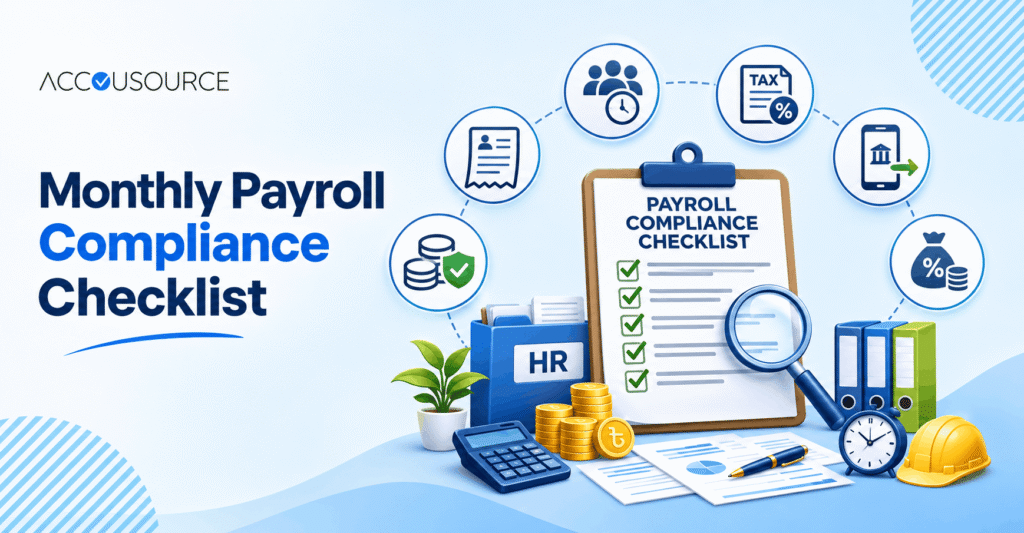
- Attendance, leave and overtime locked before payroll runs
- Tax deducted at the average rate for each employee
- Salaries paid by bank or MFS within seven working days
- Withheld tax deposited within the deadline
- PF and gratuity contributions recorded correctly
- Payslips issued and the wage register updated
- Quarterly withholding return filed (October, January, April, July)
When to Outsource Payroll
If you run a growing team, employ expatriates, or don’t have a tax specialist in-house, a payroll partner can take on calculations, deposits and filings for you. Your HR team keeps the approvals. Read our comparison of [in-house vs outsourced payroll in Bangladesh] to see which option fits you.
AccouSource runs compliant payroll for local and foreign companies in Bangladesh, covering salary calculation, tax, PF and gratuity, and statutory filings. [Get a payroll health check →]