In-house payroll works best for large companies that already have an HR and finance team with tax expertise, and stable, simple pay structures. Outsourced payroll usually wins for small and mid-sized companies, multinational subsidiaries, and any business with expatriates, shift workers or frequent rule changes to track.
Below, we compare both models on cost, compliance and control, so you can decide which fits your business in Bangladesh.
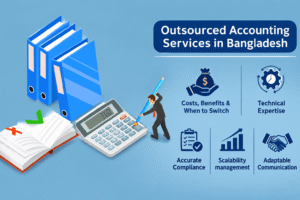
This guide covers what outsourced accounting includes, how the costs compare, the risks to manage, and the signs it’s time to switch.
How In-House Payroll Works
With in-house payroll, your own HR or accounts team collects attendance and leave data and calculates gross pay, overtime and deductions. They also compute tax at source, prepare bank files, pay salaries, deposit tax, and file quarterly withholding returns.
The visible cost is the payroll officer’s salary and the software licence. The hidden costs are the ones that hurt:
- Time spent keeping up with changes such as the Finance Act 2026 tax slabs and the 2025–26 Labour Act amendments
- Penalties and interest when tax is under-deducted or deposited late
- Disallowed salary expenses when PSR records are missing
- Disruption when the one person who knows the payroll leaves
How Outsourced Payroll Works
With outsourced payroll, a specialist provider runs the calculations and compliance. Your team stays in charge of approvals. A typical monthly cycle:
- You send attendance, leave, joiners, leavers and pay changes by a fixed cut-off date.
- The provider calculates salaries, overtime, bonuses, tax, PF and other deductions.
- You review and approve the payroll register.
- The provider prepares bank or MFS payment files and payslips.
- The provider deposits withheld tax and files statutory returns on time.
Good providers also handle year-end salary statements, final settlements and payroll reports for audits.
| Factor | In-house payroll | Outsourced payroll |
|---|---|---|
|
Cost
|
Salary, benefits, software and training for payroll staff
|
Per-employee or fixed monthly fee
|
|
Compliance risk
|
Depends on one or two people keeping up with law changes
|
Specialist team tracks the Labour Act, ITA 2023 and Finance Act changes
|
|
Control
|
Full, day-to-day control
|
You approve every payroll, and the provider executes
|
|
Confidentiality
|
Salary data seen by internal staff
|
Salary data kept outside the office, protected by a confidentiality agreement
|
|
Scalability
|
Needs more staff as headcount grows
|
Scales with no new hires
|
|
Expertise
|
Usually general HR or accounts staff
|
Payroll and tax specialists
|
|
Technology
|
You buy and maintain the system
|
Provider’s platform, often with an employee self-service portal
|
|
Continuity
|
At risk when staff leave
|
Built into the service
|
Many companies find confidentiality a reason to outsource. Senior salaries stay out of sight of internal staff.
Which Option Fits You?
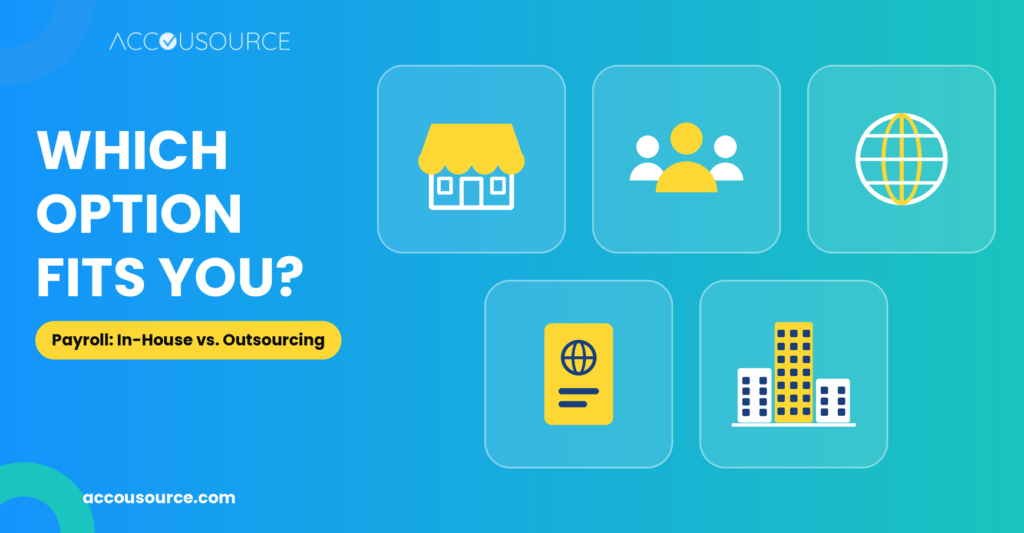
Under 20 employees. Outsource. A dedicated payroll hire rarely makes sense, and mistakes cost more than the provider’s fee.
20–200 employees. Usually outsource, or use a hybrid model. Payroll complexity grows quickly with shift work, overtime, incentives and turnover.
Multinational subsidiaries. Outsource. The parent company needs reliable compliance, group-format reports and confidentiality, without building a local payroll team.
Companies with expatriates. Outsource. Expat payroll adds residency tests, tax on benefits, work-permit conditions and sometimes split payments across countries.
Large companies with an established HR and finance team. In-house can work well, often with a specialist on call to review rule changes.
The Hybrid Model
Many companies in Bangladesh choose a middle path. HR keeps employee records, approvals and communication with staff. The provider handles calculations, tax, statutory filings and payslips. This keeps control and employee relationships in-house while moving compliance risk to specialists.
How to Switch Without Disrupting Salaries
- Choose your start month. The start of a quarter, or July (the start of the income year), makes tax reconciliation easier.
- Share data. Employee master data, salary structures, year-to-date earnings and tax deducted, PF balances and leave balances.
- Run in parallel. Run one month on both systems and compare the results line by line.
- Agree on cut-offs. Fix dates for inputs, approval and payment, so salaries stay within the seven-working-day deadline.
- Go live. Tell employees about any new payslip format or self-service portal.
Outsource Your Payroll with AccouSource
AccouSource runs accurate, confidential payroll for local companies, multinational subsidiaries and expat teams in Bangladesh. We cover tax deducted at source, PF, gratuity, final settlements and statutory filings. [Get a payroll quote →]